给定如下策略(令γ = 0.9 \gamma=0.9 γ = 0.9
贝尔曼公式:
v π ( s 1 ) = − 1 + γ v π ( s 2 ) , v π ( s 2 ) = + 1 + γ v π ( s 4 ) , v π ( s 3 ) = + 1 + γ v π ( s 4 ) , v π ( s 4 ) = + 1 + γ v π ( s 4 ) . \begin{aligned}
v_{\pi}(s_1) &= -1 + \gamma v_{\pi}(s_2), \\
v_{\pi}(s_2) &= +1 + \gamma v_{\pi}(s_4), \\
v_{\pi}(s_3) &= +1 + \gamma v_{\pi}(s_4), \\
v_{\pi}(s_4) &= +1 + \gamma v_{\pi}(s_4).
\end{aligned} v π ( s 1 ) v π ( s 2 ) v π ( s 3 ) v π ( s 4 ) = − 1 + γ v π ( s 2 ) , = + 1 + γ v π ( s 4 ) , = + 1 + γ v π ( s 4 ) , = + 1 + γ v π ( s 4 ) . 解方程组得
State values: v π ( s 4 ) = v π ( s 3 ) = v π ( s 2 ) = 10 , v π ( s 1 ) = 8 v_{\pi}(s_4) = v_{\pi}(s_3) = v_{\pi}(s_2) = 10, v_{\pi}(s_1) = 8 v π ( s 4 ) = v π ( s 3 ) = v π ( s 2 ) = 10 , v π ( s 1 ) = 8
有了state value之后我们可以计算action values:
q π ( s 1 , a 1 ) = − 1 + γ v π ( s 1 ) = 6.2 , q π ( s 1 , a 2 ) = − 1 + γ v π ( s 2 ) = 8 , q π ( s 1 , a 3 ) = 0 + γ v π ( s 3 ) = 9 , q π ( s 1 , a 4 ) = − 1 + γ v π ( s 1 ) = 6.2 , q π ( s 1 , a 5 ) = 0 + γ v π ( s 1 ) = 7.2. \begin{aligned}
q_{\pi}(s_1, a_1) &= -1 + \gamma v_{\pi}(s_1) = 6.2, \\
q_{\pi}(s_1, a_2) &= -1 + \gamma v_{\pi}(s_2) = 8, \\
q_{\pi}(s_1, {\color{blue}a_3}) &= 0 + \gamma v_{\pi}(s_3) = 9, \\
q_{\pi}(s_1, a_4) &= -1 + \gamma v_{\pi}(s_1) = 6.2, \\
q_{\pi}(s_1, a_5) &= 0 + \gamma v_{\pi}(s_1) = 7.2.
\end{aligned} q π ( s 1 , a 1 ) q π ( s 1 , a 2 ) q π ( s 1 , a 3 ) q π ( s 1 , a 4 ) q π ( s 1 , a 5 ) = − 1 + γ v π ( s 1 ) = 6.2 , = − 1 + γ v π ( s 2 ) = 8 , = 0 + γ v π ( s 3 ) = 9 , = − 1 + γ v π ( s 1 ) = 6.2 , = 0 + γ v π ( s 1 ) = 7.2.
接下来的问题是 While the policy is not good, how can we improve it? \color{blue}\text{While the policy is not good, how can we improve it?} While the policy is not good, how can we improve it?
Answer: We can improve the policy based on action values
目前的π ( a ∣ s 1 ) \pi(a|s_1) π ( a ∣ s 1 )
π ( a ∣ s 1 ) = { 1 a = a 2 0 a ≠ a 2 \pi(a|s_1) = \begin{cases}
1 & a = a_2 \\
0 & a \neq a_2
\end{cases} π ( a ∣ s 1 ) = { 1 0 a = a 2 a = a 2 显然这个策略不够好,因为从s 1 s_1 s 1 a 2 a_2 a 2
观察上面的action value,q π ( s 1 , a 3 ) q_{\pi}(s_1,a_3) q π ( s 1 , a 3 )
π ⋆ ( a ∣ s 1 ) = { 1 a = a 3 0 a ≠ a 3 \pi_{\star}(a|s_1) = \begin{cases}
1 & a = a_3 \\
0 & a \neq a_3
\end{cases} π ⋆ ( a ∣ s 1 ) = { 1 0 a = a 3 a = a 3 The state value could be used to evaluate if a policy is good or not: if
v π 1 ( s ) ≥ v π 2 ( s ) for all s ∈ S v_{\pi_1}(s) \geq v_{\pi_2}(s) \quad \text{for all } s \in \mathcal{S} v π 1 ( s ) ≥ v π 2 ( s ) for all s ∈ S then π 1 \pi_1 π 1 π 2 \pi_2 π 2
The definition leads to many questions:
Does the optimal policy exist?
Is the optimal policy unique?
Is the optimal policy stochastic or deterministic?
How to obtain the optimal policy?
To answer these questions, we study the Bellman optimality equation .
贝尔曼方程(element-wise form)
v π ( s ) = ∑ a π ( a ∣ s ) [ ∑ r p ( r ∣ s , a ) r + γ ∑ s ′ p ( s ′ ∣ s , a ) v π ( s ′ ) ] , s ∈ S v_{\pi}(s) = \sum_{a} \pi(a|s) \left[ \sum_{r} p(r|s, a) r + \gamma \sum_{s'} p(s'|s, a) v_{\pi}(s') \right], \quad s \in \mathcal S v π ( s ) = a ∑ π ( a ∣ s ) [ r ∑ p ( r ∣ s , a ) r + γ s ′ ∑ p ( s ′ ∣ s , a ) v π ( s ′ ) ] , s ∈ S 右侧加上取最大值,得到Bellman optimality equation (BOE)
v ( s ) = max π ∑ a π ( a ∣ s ) ( ∑ r p ( r ∣ s , a ) r + γ ∑ s ′ p ( s ′ ∣ s , a ) v ( s ′ ) ) , s ∈ S = max π ∑ a π ( a ∣ s ) q ( s , a ) , s ∈ S \begin{aligned}
v(s) &= {\color{blue}\max_{\pi}} \sum_{a} {\color{blue}\pi(a|s)} \left( \sum_{r} p(r|s, a) r + \gamma \sum_{s'} p(s'|s, a) v(s') \right), \quad s \in \mathcal{S} \\
&= {\color{blue}\max_{\pi}} \sum_{a} {\color{blue}\pi(a|s)} q(s, a), \quad s \in \mathcal{S}
\end{aligned} v ( s ) = π m a x a ∑ π ( a ∣ s ) ( r ∑ p ( r ∣ s , a ) r + γ s ′ ∑ p ( s ′ ∣ s , a ) v ( s ′ ) ) , s ∈ S = π m a x a ∑ π ( a ∣ s ) q ( s , a ) , s ∈ S Remarks:
p ( r ∣ s , a ) , p ( s ′ ∣ s , a ) , r , γ p(r|s,a), p(s'|s,a), r, \gamma p ( r ∣ s , a ) , p ( s ′ ∣ s , a ) , r , γ v ( s ) , v ( s ′ ) v(s), v(s') v ( s ) , v ( s ′ ) Is π ( s ) \pi(s) π ( s )
贝尔曼公式π \pi π arg max π ∑ a π ( a ∣ s ) q ( s , a ) , s ∈ S {\color{blue}\argmax_{\pi}} \sum_{a} {\color{blue}\pi(a|s)} q(s, a), \quad s \in \mathcal{S} arg max π ∑ a π ( a ∣ s ) q ( s , a ) , s ∈ S
Bellman optimality equation (matrix-vector form):
v = max π ( r π + γ P π v ) {\color{red}v = \max_{\pi}(r_{\pi} + \gamma P_{\pi} v)} v = π m a x ( r π + γ P π v ) where the elements corresponding to s s s s ′ s' s ′
[ r π ] s ≜ ∑ a π ( a ∣ s ) ∑ r p ( r ∣ s , a ) r , [ P π ] s , s ′ = p ( s ′ ∣ s ) ≜ ∑ a π ( a ∣ s ) ∑ s ′ p ( s ′ ∣ s , a ) \begin{aligned}
[r_{\pi}]_s &\triangleq \sum_{a} \pi(a|s) \sum_{r} p(r|s, a) r, \\
[P_{\pi}]_{s,s'} &= p(s'|s) \triangleq \sum_{a} \pi(a|s) \sum_{s'} p(s'|s, a)
\end{aligned} [ r π ] s [ P π ] s , s ′ ≜ a ∑ π ( a ∣ s ) r ∑ p ( r ∣ s , a ) r , = p ( s ′ ∣ s ) ≜ a ∑ π ( a ∣ s ) s ′ ∑ p ( s ′ ∣ s , a ) Here max π \max_{\pi} max π
max π [ ∗ ⋮ ∗ ] = [ max π ( s 1 ) ∗ ⋮ max π ( s n ) ∗ ] \max_{\pi} \begin{bmatrix} * \\ \vdots \\ * \end{bmatrix} = \begin{bmatrix} \max_{\pi(s_1)} * \\ \vdots \\ \max_{\pi(s_n)} * \end{bmatrix} π max ∗ ⋮ ∗ = max π ( s 1 ) ∗ ⋮ max π ( s n ) ∗ 注意这里max作用于一个向量的时候是逐元素的,上面向量中也把下标写成了max π ( s i ) \max_{\pi(s_i)} max π ( s i )
更准确的可以写成:
[ max π ( ⋅ ∣ s 1 ) F s 1 ( π ) max π ( ⋅ ∣ s 2 ) F s 2 ( π ) ⋮ max π ( ⋅ ∣ s n ) F s n ( π ) ]
\begin{bmatrix}
\max_{\pi(\cdot|s_1)}F_{s_1}(\pi)\\
\max_{\pi(\cdot|s_2)}F_{s_2}(\pi)\\
\vdots\\
\max_{\pi(\cdot|s_n)}F_{s_n}(\pi)
\end{bmatrix}
max π ( ⋅ ∣ s 1 ) F s 1 ( π ) max π ( ⋅ ∣ s 2 ) F s 2 ( π ) ⋮ max π ( ⋅ ∣ s n ) F s n ( π ) 因为一个完整 policy π \pi π
π = { π ( ⋅ ∣ s 1 ) , π ( ⋅ ∣ s 2 ) , … , π ( ⋅ ∣ s n ) } \boxed{
\pi=
\{
\pi(\cdot|s_1),
\pi(\cdot|s_2),
\dots,
\pi(\cdot|s_n)
\}
} π = { π ( ⋅ ∣ s 1 ) , π ( ⋅ ∣ s 2 ) , … , π ( ⋅ ∣ s n )} 也就是说,policy 是每个状态下 action 概率分布的集合。上面的向量中每个分量求出π ( ⋅ ∣ s i ) \pi(\cdot | s_i) π ( ⋅ ∣ s i ) π \pi π
v ( s ) = max π ∑ a π ( a ∣ s ) ( ∑ r p ( r ∣ s , a ) r + γ ∑ s ′ p ( s ′ ∣ s , a ) v ( s ′ ) ) , s ∈ S = max π ∑ a π ( a ∣ s ) q ( s , a ) , s ∈ S \begin{aligned}
v(s) &= {\color{blue}\max_{\pi}} \sum_{a} {\color{blue}\pi(a|s)} \left( \sum_{r} p(r|s, a) r + \gamma \sum_{s'} p(s'|s, a) v(s') \right), \quad s \in \mathcal{S} \\
&= {\color{blue}\max_{\pi}} \sum_{a} {\color{blue}\pi(a|s)} q(s, a), \quad s \in \mathcal{S}
\end{aligned} v ( s ) = π m a x a ∑ π ( a ∣ s ) ( r ∑ p ( r ∣ s , a ) r + γ s ′ ∑ p ( s ′ ∣ s , a ) v ( s ′ ) ) , s ∈ S = π m a x a ∑ π ( a ∣ s ) q ( s , a ) , s ∈ S 由于π \pi π q ( s , a ) q(s,a) q ( s , a )
= max a ∈ A ( s ) q ( s , a ) = \color{red} \max_{a \in \mathcal A(s)} q(s,a) = a ∈ A ( s ) m a x q ( s , a ) where the optimality is achieved when
π ( a ∣ s ) = { 1 a = a ∗ 0 a ≠ a ∗ \pi(a|s) = \begin{cases}
1 & a = a^* \\
0 & a \neq a^*
\end{cases} π ( a ∣ s ) = { 1 0 a = a ∗ a = a ∗ where a ∗ = arg max a q ( s , a ) a^* = \arg\max_a q(s,a) a ∗ = arg max a q ( s , a )
The BOE is v = max π ( r π + γ P π v ) v = \max_{\pi}(r_{\pi} + \gamma P_{\pi} v) v = max π ( r π + γ P π v )
f ( v ) : = m a x π ( r π + γ P π v ) f(v) := max_{\pi} (r_{\pi} + \gamma P_{\pi} v) f ( v ) := ma x π ( r π + γ P π v ) BOE becomes:
v = f ( v ) v=f(v) v = f ( v ) 因为这是向量形式,拆开:
v = [ v ( s 1 ) v ( s 2 ) ⋮ v ( s n ) ] = [ [ f ( v ) ] s 1 [ f ( v ) ] s 2 ⋮ [ f ( v ) ] s n ] v=
\begin{bmatrix}
v(s_1)\\
v(s_2)\\
\vdots\\
v(s_n)
\end{bmatrix}
=
\begin{bmatrix}
[f(v)]_{s_1}\\
[f(v)]_{s_2}\\
\vdots\\
[f(v)]_{s_n}
\end{bmatrix} v = v ( s 1 ) v ( s 2 ) ⋮ v ( s n ) = [ f ( v ) ] s 1 [ f ( v ) ] s 2 ⋮ [ f ( v ) ] s n where
[ f ( v ) ] s = max π ∑ a π ( a ∣ s ) q ( s , a ) , s ∈ S [f(v)]_s = \max_{\pi} \sum_{a} \pi(a|s) q(s,a), \quad s \in \mathcal{S} [ f ( v ) ] s = π max a ∑ π ( a ∣ s ) q ( s , a ) , s ∈ S
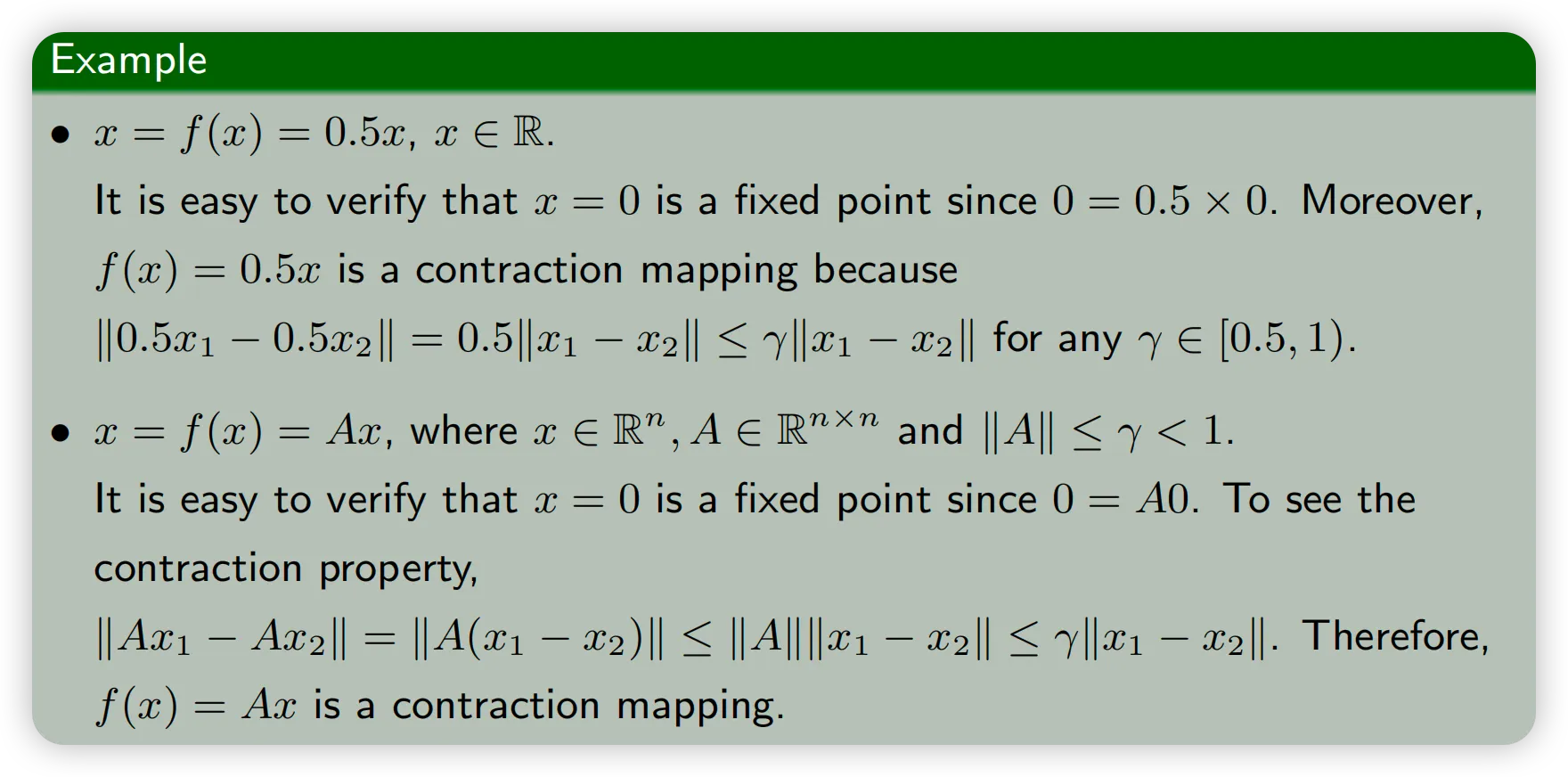
Fixed point : x ∈ X x \in X x ∈ X f : X → X f : X \to X f : X → X
f ( x ) = x f(x) = x f ( x ) = x
Contraction mapping (or contractive function) : f f f
∥ f ( x 1 ) − f ( x 2 ) ∥ ≤ γ ∥ x 1 − x 2 ∥ \|f(x_1) - f(x_2)\| \leq \gamma \|x_1 - x_2\| ∥ f ( x 1 ) − f ( x 2 ) ∥ ≤ γ ∥ x 1 − x 2 ∥ where γ ∈ ( 0 , 1 ) \gamma \in (0, 1) γ ∈ ( 0 , 1 )
γ \gamma γ γ k → 0 \gamma^k \to 0 γ k → 0 k → 0 k \to 0 k → 0 Here ∥ ⋅ ∥ \|\cdot\| ∥ ⋅ ∥
norm
∥ ⋅ ∥ can be any vector norm \|\cdot\|\text{ can be any vector norm} ∥ ⋅ ∥ can be any vector norm
∥ x ∥ 1 = ∑ i ∣ x i ∣ ∥ x ∥ 2 = ∑ i x i 2 \|x\|_1=\sum_i|x_i| \\
\|x\|_2=\sqrt{\sum_i x_i^2} ∥ x ∥ 1 = i ∑ ∣ x i ∣ ∥ x ∥ 2 = i ∑ x i 2 或者
∥ x ∥ ∞ = max i ∣ x i ∣ \|x\|_\infty=\max_i|x_i| ∥ x ∥ ∞ = i max ∣ x i ∣ 但是一旦你选定了某种向量 norm,矩阵∣ ∣ A ∣ ∣ ||A|| ∣∣ A ∣∣
∥ A ∥ = sup x ≠ 0 ∥ A x ∥ ∥ x ∥ \boxed{
\|A\|
=
\sup_{x\neq0}
\frac{\|Ax\|}{\|x\|}
} ∥ A ∥ = x = 0 sup ∥ x ∥ ∥ A x ∥ 意思是:矩阵 A A A
所以你选什么向量 norm,就会诱导出相应的矩阵 norm。由这个定义:
∥ A ∥ ≥ ∥ A x ∥ ∥ x ∥ , ∀ x ≠ 0 ⟺ ∥ A ∥ ∥ x ∥ ≥ ∥ A x ∥ , ∀ x ≠ 0 \|A\| \ge \frac{\|Ax\|}{\|x\|} , \quad \forall x \neq 0 \\
\iff \|A\| \|x\| \ge \|Ax\|, \quad \forall x \neq 0 ∥ A ∥ ≥ ∥ x ∥ ∥ A x ∥ , ∀ x = 0 ⟺ ∥ A ∥∥ x ∥ ≥ ∥ A x ∥ , ∀ x = 0 Theorem (Contraction Mapping Theorem)
For any equation that has the form of x = f ( x ) x = f(x) x = f ( x ) f f f
Existence : there exists a fixed point x ∗ x^* x ∗ f ( x ∗ ) = x ∗ f(x^*) = x^* f ( x ∗ ) = x ∗ Uniqueness : The fixed point x ∗ x^* x ∗ Algorithm : Consider a sequence { x k } \{x_k\} { x k } x k + 1 = f ( x k ) x_{k+1} = f(x_k) x k + 1 = f ( x k ) x k → x ∗ x_k \to x^* x k → x ∗ k → ∞ k \to \infty k → ∞ 这里这个Algorithm迭代法,画成函数图像比较像蛛网模型
Let’s come back to the Bellman optimality equation:
v = f ( v ) = max π ( r π + γ P π v ) v = f(v) = \max_{\pi}(r_{\pi} + \gamma P_{\pi} v) v = f ( v ) = π max ( r π + γ P π v ) Theorem (Contraction Property)
f ( v ) f(v) f ( v )
∥ f ( v 1 ) − f ( v 2 ) ∥ ≤ γ ∥ v 1 − v 2 ∥ \|f(v_1) - f(v_2)\| \leq \gamma \|v_1 - v_2\| ∥ f ( v 1 ) − f ( v 2 ) ∥ ≤ γ ∥ v 1 − v 2 ∥ where γ \gamma γ
(证明没看qaq)
既然贝尔曼最优方程已经满足contraction property,那么直接用上contraction mapping theorem
Theorem (Existence, Uniqueness, and Algorithm)
For the BOE v = f ( v ) = max π ( r π + γ P π v ) v = f(v) = \max_{\pi}(r_{\pi} + \gamma P_{\pi} v) v = f ( v ) = max π ( r π + γ P π v ) exists a solution v ∗ v^* v ∗ unique . The solution could be solved iteratively by
v k + 1 = f ( v k ) = max π ( r π + γ P π v k ) (1) v_{k+1} = f(v_k) = \max_{\pi}(r_{\pi} + \gamma P_{\pi} v_k) \tag{1} v k + 1 = f ( v k ) = π max ( r π + γ P π v k ) ( 1 ) This sequence { v k } \{v_k\} { v k } v ∗ v^* v ∗ exponentially fast given any initial guess v 0 v_0 v 0 γ \gamma γ
Important: The algorithm in (1) is called the value iteration algorithm . We will analyze it in the next lecture! This lecture focuses more on the fundamental properties.
Suppose v ⋆ v^{\star} v ⋆
v ⋆ = max π ( r π + γ P π v ⋆ ) v^{\star} = \max_{\pi} (r_{\pi} + \gamma P_{\pi} v^{\star}) v ⋆ = π max ( r π + γ P π v ⋆ ) 设:
π ⋆ = arg max π ( r π + γ P π v ⋆ ) \pi^{\star} = \arg \max_{\pi} (r_{\pi} + \gamma P_{\pi} v^{\star}) π ⋆ = arg π max ( r π + γ P π v ⋆ ) 则:
v ⋆ = r π ⋆ + γ P π ⋆ v ⋆ v^{\star} = r_{\pi^{\star}} + \gamma P_{\pi^{\star}} v^{\star} v ⋆ = r π ⋆ + γ P π ⋆ v ⋆ 此时π ⋆ \pi^{\star} π ⋆ v ⋆ = v π ⋆ v^{\star} = v_{\pi^{\star}} v ⋆ = v π ⋆ π ⋆ \pi^{\star} π ⋆
并且我们有结论,π ⋆ \pi^{\star} π ⋆ v ⋆ v^{\star} v ⋆
Theorem(Policy Optimality)
Suppose That v ⋆ v^{\star} v ⋆ v = max π ( r π + γ + P π v ) v = \max_{\pi} (r_{\pi} + \gamma + P_{\pi} v) v = max π ( r π + γ + P π v ) v π v_{\pi} v π v π = r π + γ + P π v π v_{\pi} = r_{\pi} + \gamma + P_{\pi} v_{\pi} v π = r π + γ + P π v π π \pi π
v ⋆ ≥ v π , ∀ π v^{\star} \ge v_{\pi}, \quad \forall \pi v ⋆ ≥ v π , ∀ π What does an optimal policy π ⋆ \pi^\star π ⋆
π ⋆ ( s ) = arg max π ∑ a π ( a ∣ s ) ( ∑ r p ( r ∣ s , a ) r + γ ∑ s ′ p ( s ′ ∣ s , a ) v ⋆ ( s ′ ) ) ⏟ q ⋆ ( s , a ) \pi^\star(s) = \arg\max_{\pi} \sum_a \pi(a|s) \underbrace{\left( \sum_r p(r|s,a) r + \gamma \sum_{s'} p(s'|s,a) v^\star(s') \right)}_{q^\star(s,a)} π ⋆ ( s ) = arg π max a ∑ π ( a ∣ s ) q ⋆ ( s , a ) ( r ∑ p ( r ∣ s , a ) r + γ s ′ ∑ p ( s ′ ∣ s , a ) v ⋆ ( s ′ ) ) Theorem (Greedy Optimal Policy)
For any s ∈ S s \in \mathcal{S} s ∈ S the deterministic greedy policy
π ⋆ ( a ∣ s ) = { 1 a = a ⋆ ( s ) 0 a ≠ a ⋆ ( s ) \pi^\star(a|s) = \begin{cases} 1 & a = a^\star(s) \\ 0 & a \neq a^\star(s) \end{cases} π ⋆ ( a ∣ s ) = { 1 0 a = a ⋆ ( s ) a = a ⋆ ( s ) (因为这里是π \pi π q ⋆ q^{\star} q ⋆
is an optimal policy solving the BOE. Here,
a ⋆ ( s ) = arg max a q ⋆ ( a , s ) , a^\star(s) = \arg\max_a q^\star(a, s), a ⋆ ( s ) = arg a max q ⋆ ( a , s ) , where q ⋆ ( s , a ) ≐ ∑ r p ( r ∣ s , a ) r + γ ∑ s ′ p ( s ′ ∣ s , a ) v ⋆ ( s ′ ) q^\star(s, a) \doteq \sum_r p(r|s,a) r + \gamma \sum_{s'} p(s'|s,a) v^\star(s') q ⋆ ( s , a ) ≐ ∑ r p ( r ∣ s , a ) r + γ ∑ s ′ p ( s ′ ∣ s , a ) v ⋆ ( s ′ )
What factors determine the optimal state value and optimal policy?
It can be clearly seen from the BOE
v ( s ) = max π ∑ a π ( a ∣ s ) ( ∑ r p ( r ∣ s , a ) r + γ ∑ s ′ p ( s ′ ∣ s , a ) v ( s ′ ) ) v(s) = \max_{\pi} \sum_a \pi(a|s) \left( \sum_r {\color{red}p(r|s,a) r} + {\color{red}\gamma } \sum_{s'} {\color{red} p(s'|s,a) v(s')} \right) v ( s ) = π max a ∑ π ( a ∣ s ) ( r ∑ p ( r ∣ s , a ) r + γ s ′ ∑ p ( s ′ ∣ s , a ) v ( s ′ ) ) 这里红色的量是已知的(γ , r \gamma, r γ , r π \pi π v v v
that there are three factors:
System model: p ( s ′ ∣ s , a ) p(s'|s,a) p ( s ′ ∣ s , a ) p ( r ∣ s , a ) p(r|s,a) p ( r ∣ s , a )
Reward design: r r r
Discount rate: γ \gamma γ
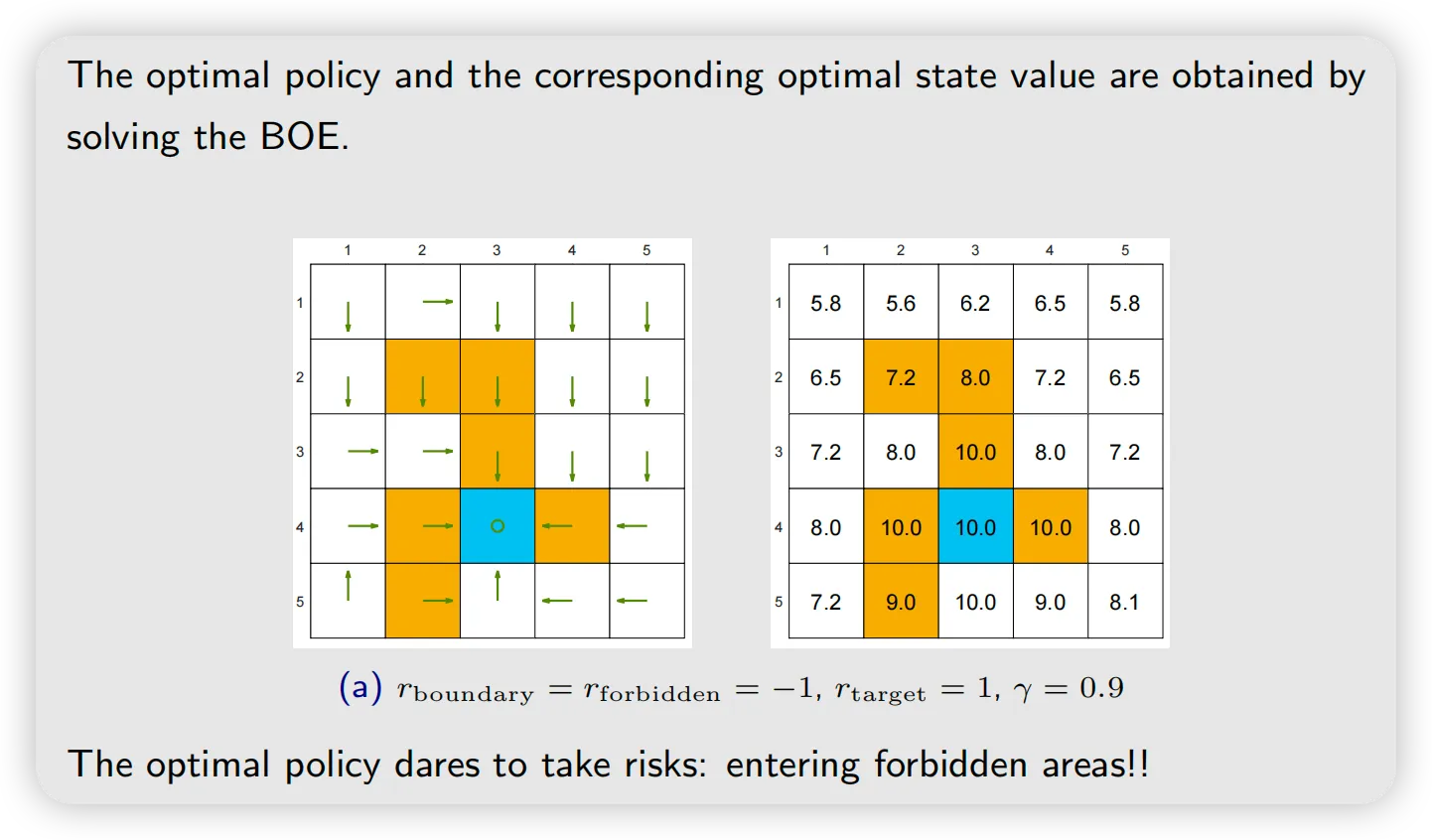
We next show how r r r γ \gamma γ
r o t h e r s t e p = 0 r_{otherstep} = 0 r o t h er s t e p = 0
主要的规律是:
γ \gamma γ γ \gamma γ γ = 0 \gamma = 0 γ = 0 r r r r → a r + b r \rightarrow ar+b r → a r + b γ < 1 \gamma < 1 γ < 1 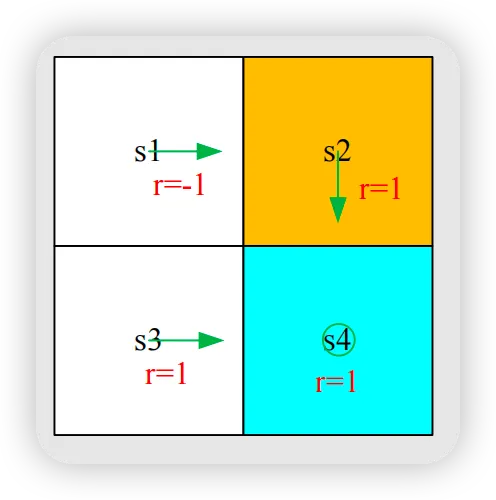
 这里有一个隐藏条件